The GreenSouth project started in January 2025 and will end in December 2027.
We divided the work into 5 work packages:
WP1:
Project Management
WP2:
Innovative VET approaches
WP3:
Curriculum and e-learning development
WP4:
Capacity building and cross-border collaboration
WP5:
Impact and dissemination
Project Management

Innovative VET Approaches
This report is the result of an extensive participatory process involving farmers, trainers, VET providers, community initiatives, and sector experts across South Africa, Zimbabwe, and Mozambique. Through interviews, field visits, workshops, and public–private dialogue, the project explored what skills are truly needed to strengthen biodynamic, organic, and agroecological farming in real-life contexts.
Read More
Rather than focusing only on technical agricultural knowledge, the findings highlight five deeply interconnected skill areas:
- economic and livelihood realities,
- agriculture as part of community building,
- agricultural skills in context,
- landscape-level and indigenous knowledge, and
- learning and teaching processes grounded in experience, mentorship, and accompaniment.
Based on these insights, in the report three innovative vocational education and training (VET) approaches are identified that respond to current skills gaps and emerging labour market needs:
- on-farm learning and apprenticeship pathways,
- lighthouse farms and a regional learning library, and
- modular, problem-based, community-rooted training.
This report provides an evidence-based foundation for the next phase of the GreenSouth project. Its findings directly inform the development of curricula, training-of-trainers programs, and learning tools in Work Package 3, supporting VET providers in becoming strong, community-rooted institutions for regenerative agriculture.
A Guideline for Formulating Questions to Research Learning Needs
This document introduces the concept of the threefold human being—thinking, feeling, and willing—as a practical tool for shaping dialogues, interviews, and questionnaires within the GreenSouth project.
Read More
Building on this foundation, the guideline shows how the way questions are asked influences the depth and quality of responses. Instead of focusing on abstract expectations or wishes, it encourages questions grounded in lived experience and concrete action.
Drawing on anthroposophy, biodynamic practice, and praxis-oriented research, the document offers practical insights into interview settings, conversational context, scaling questions, and evaluation. It also introduces the use of narrative analysis and Grounded Theory to work with experiential answers and to inform curriculum development and training design within the GreenSouth project.
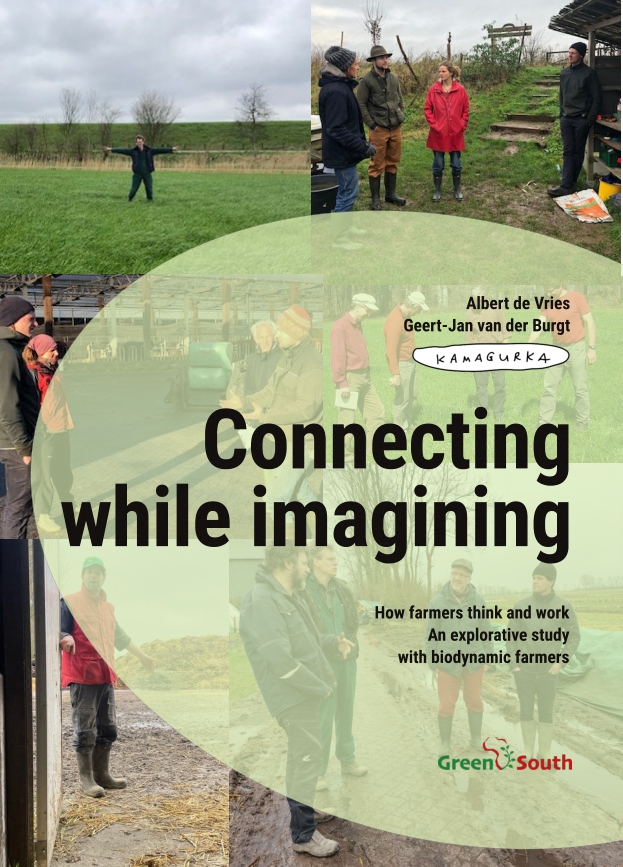
The study opens to deeper insights and understanding of some of the often invisible essences of the practice of biodynamic agriculture. This makes the study an important contribution to initiatives like Greensouth, that I am part of, in which we are seeking to develop vocational training springing from the needs and realities of Southern Africa. We already know that to simply teach the technical skills of biodynamic farming is not enough. What are the invisible capacities that need to be transmitted to enable alive biodynamic farming to take root?
The publication by Albert de Vries appears in the context of the GreenSouth project and touches on a central point of our shared concern: how can research emerge that not only involves people, but originates from them – from their practices, their responsibilities, their desire for development?
Read More
In the GreenSouth project, we are currently preparing an educational programme for biodynamic and organic farming in South Africa, Zimbabwe and Mozambique. The aim is to create training and further education opportunities that are locally relevant and empower people in their professional lives. The concrete development of appropriate training modules is still pending. But one thing is already clear: technical knowledge alone is not enough. What is needed is a methodology that helps us to truly understand the learning and development needs of the farmers, trainers and trainees involved – from their own perspective, in their concrete practice, in their cultural and individual reality.
The methodology presented by Albert de Vries in this paper is a key resource for us in this regard. His idea of human-inclusive research focuses on people’s individual acting impulse: not as a mere starting point, but as a dynamic force from which learning processes emerge – both individually and collectively. Perceiving while empathising and aligning while empathising are not just methodological terms. They describe an attitude with which people relate to their practice, their environment and each other – an attitude that is educational in the best sense of the word.
Curriculum and E-Learning Development
More information coming soon.
Capacity Building and Cross-Border Collaboration
More information coming soon.
Impact and Dissemination

Project ID: 101182684, ERASMUS+


info@greensouth.bio